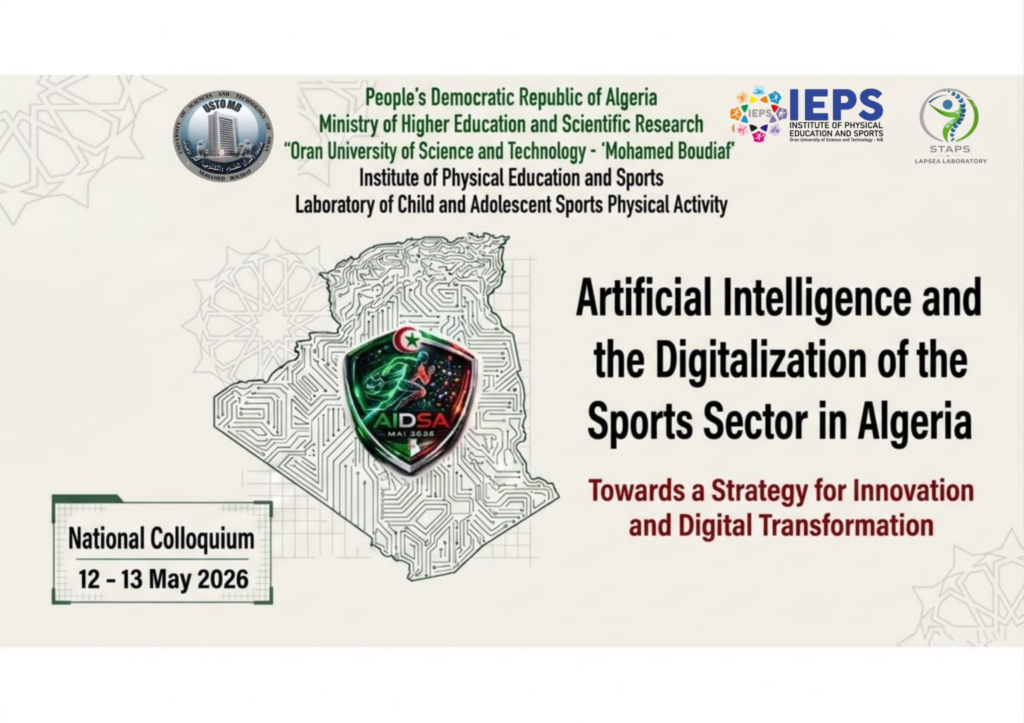
Announcement of a National Conference titled : Artificial Intelligence and Digitalization of the Sports Sector in Algeria: Towards a Strategy for Innovation and digital Transformation
Conference Problem Statement
In light of the geopolitical and economic transformations imposed by the Fourth Industrial Revolution, digital transition and artificial intelligence applications have become an inevitable necessity for developing national sports systems. This transformation is no longer limited to improving competitive performance, but has extended to include building an integrated sports economy based on innovation and Big Data monetization.
However, the sports sector in Algeria faces a technological gap, evident in the disparity between the global acceleration in adopting “data-driven sports,” machine learning algorithms, and Sports Internet of Things (Sports IoT) technologies, and the traditional management and training mechanisms prevailing locally. This gap does not merely indicate delay; rather, it represents a historic opportunity to re-engineer the sports system based on modern scientific and technological foundations.
The central problem of this conference is embodied in the following fundamental question:
How can Algerian sports institutions (academic and field-based) move beyond the stage of mere assimilation and application, towards engineering and building a Smart Sports Ecosystem that integrates data science to achieve a genuine breakthrough in competitive performance, administrative governance, and decision-making based on predictive analytics?
Sub-questions include:
• What are the structural obstacles (technical, human, and legal) that prevent comprehensive digital transformation within Algeria’s socio-economic specificities?
• How can these challenges be transformed into pioneering investment and research opportunities?
This conference seeks to break the barrier between theoretical scientific research and field practice by identifying ways to modernize performance and elevate national sports to the level of technological modernity, activating the role of academic laboratories as sandboxes for testing and developing algorithms and performance analysis applications, and opening its doors to diagnostic studies, technical research, and innovative interdisciplinary projects.

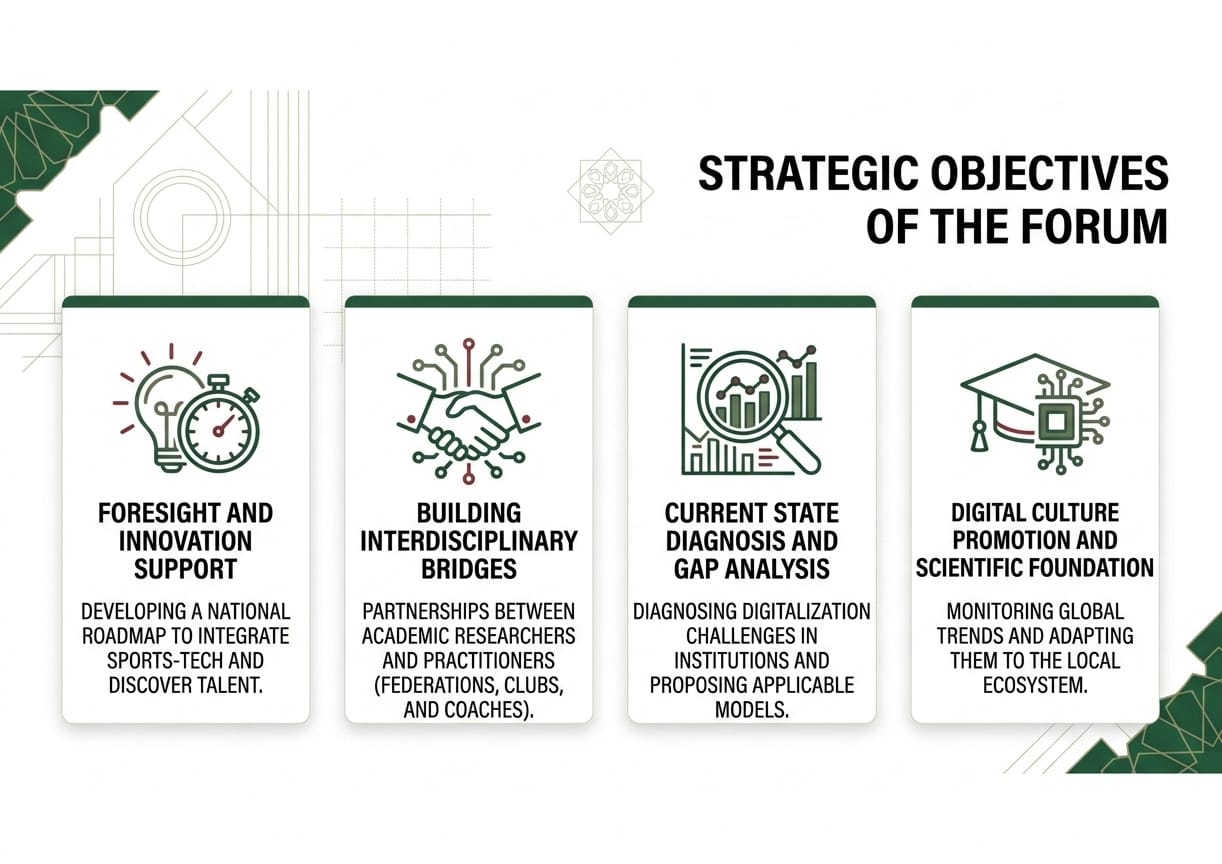
Conference Objectives
- Spreading digital culture and scientific foundation:
Monitoring modern global trends in the use of artificial intelligence in sports sciences and adapting them to the local environment. - Diagnosing reality and analyzing the gap:
Diagnosing obstacles to digitalization in Algerian sports institutions and proposing applicable technical models. - Building interdisciplinary bridges:
Creating an exchange space and research partnerships between academic researchers (in sports science and technology) and field stakeholders (federations, clubs, and coaches) to reduce the digital gap. - Foresight and innovation support:
Formulating a national roadmap for integrating smart technology into talent identification and elite athlete development systems, and encouraging emerging ideas and Sports-Tech projects.
Conference Themes
Theme One: Conceptual and Legislative Framework for Digitalization in Sports :
- Basic concepts of artificial intelligence and data science and their general applications in sports.
- Legislation, protection of personal and biometric data, and technology ethics.
- Review papers on successful international experiences in sports digital transformation.
Theme Two: Reality and Challenges of Digitalization in the Algerian Sports System
- Diagnosing the level of digital awareness and culture among coaches, administrators, and athletes.
- Digitalization in the management of sports facilities and institutions (resource management, electronic ticketing, digital sports marketing).
- Infrastructure, structural obstacles, and presentation of successful local experiences.
Theme Three: Technology and Sports Performance Analysis
- Applications of artificial intelligence, computer vision, and tracking systems in biomechanical and tactical analysis.
- Utilizing Big Data and specialized software to enhance performance.
- The role of machine learning algorithms in identifying and developing sports elites and talents.
Theme Three: Technology and Sports Performance Analysis
- Applications of artificial intelligence, computer vision, and tracking systems in biomechanical and tactical analysis.
- Utilizing Big Data and specialized software to enhance performance.
- The role of machine learning algorithms in identifying and developing sports elites and talents.
Theme Five: Innovation and Entrepreneurship in Sports Technology (Sports-Tech)
•The role of startups in providing digital solutions and financing the sports sector.
•
Internet of Things (IoT) applications and smart solutions in stadium management.
Target Groups
To achieve the conference objectives of creating an integrated environment, we welcome participation from actors in the following sectors:
- Academic and Research Sector:
Research professors and experts in physical education faculties and institutes, PhD students in technology and sports science fields, and specialists in information technology, embedded systems engineering, and data science. - Practice and Management Sector:
Coaches, technicians, and administrative staff in clubs and federations. - Healthcare Sector:
Sports medicine doctors and rehabilitation experts. - Innovation and Entrepreneurship Sector:
Software developers, innovative project holders, and startups interested in the sports economy.
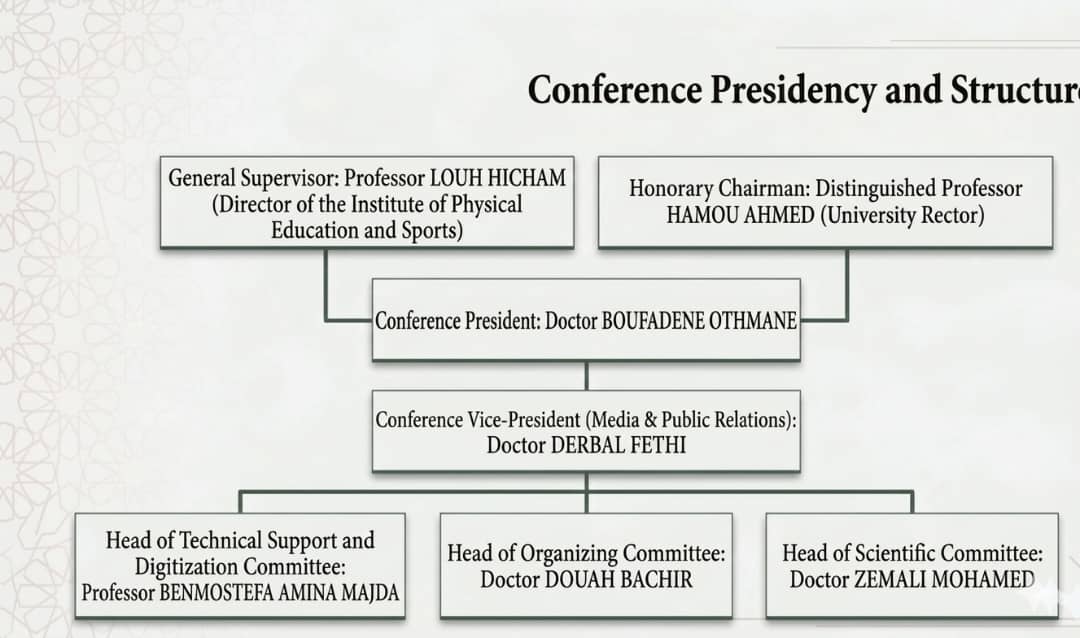
Conference Presidency and Organizational Structure
- Honorary President: Distinguished Professor Hamou Ahmed / University Rector.
- General Supervisor: Dr. Louh Hichem / Director of the Institute of Physical Education and Sports.
- Conference President: Dr. Boufadene Othmane.
- Scientific Committee President: Dr. Zemali Mohamed.
- Organizing Committee President: Dr. Douah Bachir.
- Conference Vice-President (Media & Public Relations) Committee President: Dr. Derbal Fethi.
- Technical Support and Digitalization Committee President: Dr Benmostafa Majda Amina.
Important Dates and Deadlines
Deadline for receiving abstracts/contributions: April 5, 2026.
Notification of acceptance: 23 April, 2026.
Conference dates: 12-13 May, 2026.
Venue: Institute of Physical Education and Sports – University of Oran for Science and Technology “Mohamed Boudiaf”.
Participation Conditions
Types of Accepted Contributions:
- Field and interdisciplinary research:
Joint contributions between researchers in sports sciences and technology disciplines are encouraged. - Review and conceptual papers:
Studies that survey previous literature, explain technical concepts, or present international experiences. - Descriptive and diagnostic studies:
Research assessing the reality of digitalization use through questionnaires and field measures. - Innovative projects and emerging ideas (Startups):
Presentations of innovative projects or applicable prototype technical models in the sports field
Presentation Formats:
Based on the Scientific Committee’s evaluation (and the researcher’s choice), accepted contributions will be scheduled in one of the following formats:
- Oral Presentation:
Delivered as a scheduled presentation within the conference’s scientific sessions. - Poster Presentation:
The poster will be displayed in the designated area, with time allocated for the researcher to interact directly and discuss their idea with attendees and the evaluation committee.
Presentation Languages and Contact Information:
- Presentation Languages:
Contributions are accepted in Arabic, English, and French. - Contact:
Abstracts and full papers should be sent via : https://forms.gle/SM65Mszw6pKosRTs6

Technical Formatting Standards for Research Papers:
Format and layout:
- Contributions should be submitted in Word format.
Font type for Arabic papers: Sakkal Majalla.
Font type for foreign languages: Times New Roman.
Font sizes: - Main title: 16 bold
Subtitles: 14 bold
Body text: 14 regular
Footnotes and tables: 12 regular - Margins: 2.5 cm on all sides.
Line spacing: 1.15.
Structure and Documentation System (According to the Nature of the Contribution):
- For field and interdisciplinary research:
(Introduction and problem statement, methodology, results, and final recommendations).
Length: 10 to 20 pages maximum (including references and appendices). - For review papers:
(Introduction, conceptual framework/literature review, analysis and comparison, conclusions).
Length: 10 to 20 pages. - For projects and emerging ideas:
Exempt from page requirements; to be presented as a “project sheet” (3 to 5 pages) or scientific poster, including: problem description, technological solution, and expected impact. - Abstract:
In all cases, an abstract not exceeding 250 words is required, accompanied by an abstract in a second language (English is mandatory if the paper is in Arabic), with 3 to 5 keywords. - Documentation:
The Scientific Committee adopts the American Psychological Association (APA – 7th edition) style for citations and references.
(Note: All papers are subject to blind peer review by the Scientific Committee. Any contribution that does not comply with the technical requirements will be declined on technical grounds.)
The Institute of Physical Education and Sports at the University of Science and Technology “Mohamed Boudiaf” is honored to invite all researchers and creative minds to contribute effectively to enriching this national conference, so that it may serve as a cornerstone in building an intelligent Algerian sports system that keeps pace with global challenges.
We look forward to your valuable contributions.